About The Steam Era Freightcars Blog

This blog discusses all aspects of North American freight cars of the steam era, from the dawn of railroading through 1960.
It is intended to support the efforts of model railroaders who wish to produce the most prototypically accurate freight cars possible.
Prototype modelers are encouraged to participate in this blog. Please consider sending photos of prototypes and your efforts to model them, reviews of kits, books and other products, “articles” about your modeling efforts – with or without photos. The nature of blogging means the material can be "real time," and in-process models can be shared. These are not only welcomed, but appreciated as we all love to see a model develop over time.
Also welcome is information about upcoming prototype meets, shows, and other events.
Information submitted for this blog is considered gratis. Also, all submissions must include your name and contact email.
For more information or to submit information email steamfreightcar@gmail.com.

Thursday, August 18, 2022

Dating a Photo


I don't think I'll be able to get an actual model of the Enosburg Falls condensery before the MARPM Open House (before the end of the year is more likely!) but that doesn't mean I don't want to think through what the building might look like. 

Here's a couple of views of the same side of the building (obviously the trackside of the building) from two different eras. 

Obviously the building has seem some changes - I'd like to be able to determine the era these photos were taken - it may help refine what my model for the ~1941 era model should look like. 

The shot with the GTW reefer is the later image of these two. I think the car barely visible to the extreme left is a showing the large "wiggle worm" CV logo of the post-1963 era. 

The two freight cars in the earlier picture should be able to help set a baseline to come up with a range of years for that photo. 

I believe these are a PRR drop bottom gon, maybe one like THIS Westerfield model. The ATSF boxcar is a little harder to pin down, but someone who knows Santa Fe boxcars may be able to use it to narrow down the era. 

I suspect the photo dates from sometime in the first 10-15 years of the 20th century but would like to narrow down the date. 

Saturday, July 2, 2022

Pulpwood Delivery

The CN boxcar is just one of the many interesting details visible in this photo. Jack Delano photo, Library of Congress, Sheldon Springs, Vt., September 1941. 

In the steam era boxcars hauled virtually every commodity that didn't need to be temperature controlled. That included dimensional lumber and pulpwood. 

The reporting marks on the car end are CN 511534, marking this as one of a large class (~1,700 cars) of Canadian National single sheathed boxcars. 

Sylvan Scale Models and Steam Shack (F&C) both offered these cars as HO scale resin kits over the years. And Ted Culotta's Essential Freight Cars (Number 8, November 2003 RMC) gives additional details on these cars. 


Thursday, February 18, 2021

L&N Rebuilt Boxcar


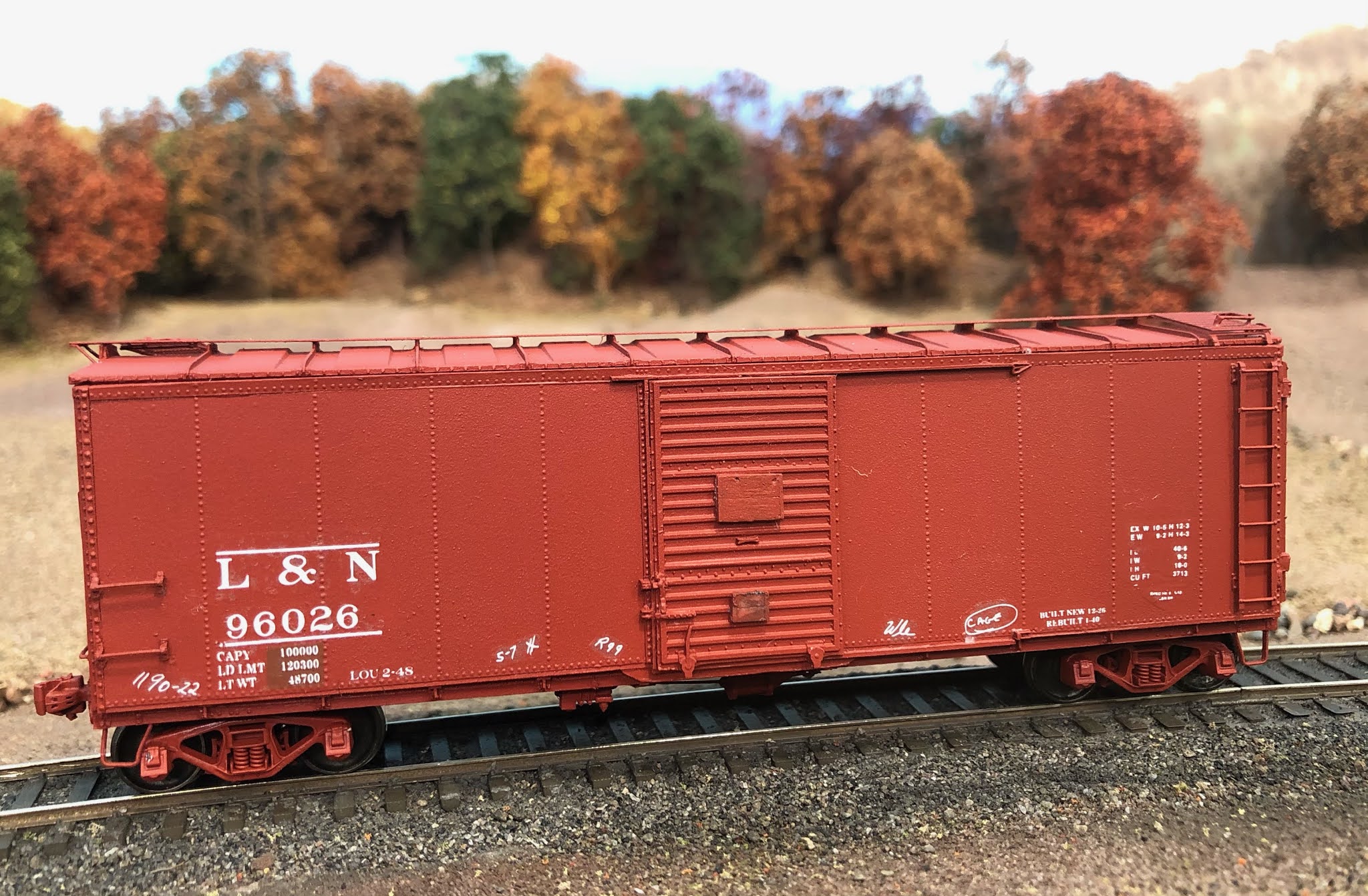
Yet another half started freight car project that I've dug out of the box and completed. This is a Sunshine Models L&N rebuilt boxcar with Murphy ends, Sunshine Kit #64.11. I likely replaced the bracket grabs, ladder, and brake wheel that came in the kit with other after market parts. I did use some bits and pieces of Speedwitch's L&N boxcar decals (which are not specifically made for this car) to complement the kit decals. The carman's chalk marks are a combination of various Sunshine decals. It obviously still needs a little running weathering. That's the basic description of thing, but there's really a little more background to why I built this particular car. 

Back when Sunshine Models hosted the Naperville RPM meets, Martin Lofton, the owner of Sunshine Models, often asked me to do an ongoing hands-on display showing people how to build these resin cars.. One "perk" for doing this was I'd often get early access to the coveted Sunshine "sale room" before it opened for the other attendees. In this case he'd sent me the kit before the meet so I could get some of the basic assembly work done beforehand. I'm not sure I would have chosen this car on my own, since I haven't seen an L&N boxcar, let alone a pre war rebuild, in a photo on my prototype. 

What really pushed this one to the top of the "finish it" pile was the passing of my good friend Bill Welch. Bill's first modeling love was the railroads of the Southeastern U. S., which he often called "Y'All Railroads." I'd gotten to know him on the prototype modeling "circuit" - and always appreciated a chance to visit with him. When I moved to the DC area Bill still lived here, and he organized several informal prototype modeling "show and tell" get togethers. Very small, very informal, and great fun. 

Bill had sent me an email in late 2019 asking for my help in designing a small switching layout. We went back and forth on that a few times, and then several months passed. It was sometime last summer he wrote to tell me of his cancer diagnosis. By November he was gone. 

I realize it's been a few months since Bill passed away, but I figured what better tribute to a friend than to finally finish up this Y'all road boxcar. 

It seemed doubly appropriate since the very last email I received from Bill was a response to my question - "What color should I paint this thing?" 

He recommended Badger's Light Tuscan Oxide Red. I don't really like Badger's paints after some truly miserable experiences with them early on. But Bill seemed adamant about this brand and color so that's the paint I used. 

Perhaps they've improved the paint somehow? 

Or perhaps Bill was looking over my shoulder? 

In any event, if you don't like the model take it up with me. But if you don't like the color, you'll have to discuss that with Bill. 


Saturday, February 6, 2021

Shaking off the (figurative) Rust

It's been quite a while since I've worked on a freight car - any freight car. I mean several years since I touched a freight car model. 

So with the layout infrastructure (benchwork, track, and wiring) completed I decided to take a break from moving forward on scenery and structures (I am working on a large structure kit, some details of which you can see HERE) to shake the rust off my freight car modeling skills and maybe get a  couple more cars out of their boxes and onto the track. 

I started by digging these two resin cars (both of which had been assembled a while back - one of them more than 25 years ago!) into the spray booth for a coat of primer. 

Then I found these three True-Line CN boxcars that I had dullcoated before we moved from the old house and played around with weathering them. 

At this point I've added a basic streaking of Burnt Umber and Black oil paints. 


Just for fun, and to try something a little different, I tried to duplicate the look of failed paint on the roof of one car. 
I used an unscientific combination of Vallejo Silver and Gunmetal Gray. Was just a little vivid at first, but a wash of Vallejo Medium Gray wash helped blend everything. 


Saturday, December 5, 2020

Richford Branch Extra - Coming and Going - and notes on a side trip to Maine


This pair of Stan Bolton images, that I am sharing courtesy of Stan's good friend George Corey, show a pair of Central Vermont Consolidations (#s 465 and 466) working the daily local through Sheldon Junction, Vt., on an obviously "chilly" February 23, 1957. 

A few of the cars are fairly easy to identify (Click on the images to enlarge). 

I'll go first - the lead car in the second image is a Central Vermont 40,000-series boxcar. Typically one of these cars was used to handle LCL on the Richford job. 

A side note:

Almost exactly two years to the day before this image was taken, no. 466 and her sister no. 471 were both sent to the Grand Trunk (NEL). No. 466 made exactly one trip - actually less than one trip - when she experienced mechanical problems on an Island Pond to Portland, ME extra and was promptly returned to the CV.  

No 471 faired much better than her sister on her assignment to Maine. She remained on the GT (NEL) through the end of August 1955 where she made 24 mainline trips, primarily on wayfreights. She even made a half dozen or so trips hauling passenger train no. 16, and spent 36 days as the Lewiston branch engine. 

Obviously the St. Albans shop crew fixed whatever ailed no. 466 and she's steaming pretty well in these shots.  


Sunday, November 29, 2020

"You don't want to rush these things ...."

 It's been far too long since I've posted on this blog (although I do a better job keeping my Central Vermont blog up to date). 

I truly hope everyone has had a happy and healthy Thanksgiving. I also sincerely hope your personal situation has been such that you've been able to spend time on trivial items like model railroading!

After having my car living in the driveway for going on a year, I took advantage of the unseasonably warm waether this weekend to (finally) clear out the garage - at least the point where both cars would fit. 

Most of the stuff was, as I suspected, items we no longer need or simply junk. They have now all found their way to the appropriate places - which means they're no longer taking up space better suited for my car! 

I did come across one plastic tote that had, among other things, several brown Westerfield boxes. After we moved out of the old house and into the temporary apartment I'd ordered several Westerfield kits as part of the November sale. (As an aside, this years sale is going on until the end of November. You can find details on the Westerfield website <HERE>). Naturally, I figured these were those kits. 

But when I got these cars into the house I noticed one of the labels had a "BUILT" notation on them. 

Sharp-eyed readers will note this is the old school Westerfield resin. Back in my Navy shipboard days I'd pick up a few Westerfield (or very early F&C) kits and bring them to build on the ship. I got a fair number of them built - especially when I was assigned to a fleet oiler. The one thing I couldn't do is paint these on the ship - so I built them and painted them when I got home. 

I'm fairly certain this is one of those cars. That would mean I started it in 1990 or 91... and it's still not finished. Thirty years from start to completion of a model - a new personal best!

The model survived its long slumber remarkably intact. One of the running board supports is gone, and the brake wheel is lost to the ages. Otherwise, it looks pretty good. It has trucks which means I must have done something with it off the ship at some point - I learned the hard way not to put trucks on the models I built on the ship - after finding a Westerfield H21 "rekitted" on the deck of the stateroom after a bouncy night of Cape Hatteras! 

I'd made note of which Floquil paint I was going to use on this model, but that doesn't do me much good. Anyone have a suggestion for a currently available paint (preferably Vallejo) that would work for this car? 

Of course, if pressed I can claim I was waiting for a better decal set to come along.

After all, you don't want to rush these things!


Monday, January 27, 2020

Crowd Funding HO scale models

The traditional method of producing an injection-molded model of a typical freight car goes something like this - 
1. A prototype is identified (usually through suggestions from dealers and/or hobbyists) as a likely "good" project by a manufacturer.
2. Inquiries are made, usually to unpaid "consultants" - most often hobbyists themselves - to obtain the information, drawings, and photos needed to develop a list of components such as doors, ends, roofs and the like, as well as paint schemes. 
3. At some point the economic reality of producing the model rears its ugly head, and it becomes obvious it's impractical to produce each possible version of the "basic" car - especially in an initial run. Most often, the goal is to recoup the R&D costs with the first run - perhaps with a small amount of profit, with the real money to follow with subsequent runs.
The cost, and time, to develop the tooling is the Achilles heal in the process. Of course, unique and low production models have been, and are continuing to be made in resin. But in the case of a factory assembled, decorated injection molded car the tooling cost can easily reach $250,000.00. Some cost even more. And on top of the tooling cost you still have a per unit manufacturing costs. For the manufacturer the risk for many otherwise appealing prototypes is too great to justify the expense. So choices are made. Often those choices mean we as modelers don't get all the models we want. 
Some manufacturers get around these limitations by producing generic cars, others use a business model that limits the model to only those details and paint schemes that are accurate. The vast majority seem to fall somewhere between the two extremes. They'll produce an accurate model for one railroad, for example, but paint and letter that same model for other railroads. Each of these "others" reflect varying degrees of accuracy. 

Crowd-sourcing a boxcar?
The folks at Prototype Junction are attempting an approach that has worked in other hobbies, primarily gaming, with some success. They are starting a crowd-funded approach to produce a model of an AT&SF Bx-11 & 12 series boxcar. It turns out other roads, including the C&O, CGW, L&N and Pere Marquette, had similar cars (with different details or components). I won't dwell on the specifics, since you can find a rather detailed set of parameters for this project HERE. 

How this works
If you're unfamiliar with crowd-funding - here's how it works. Someone establishes a project with a funding goal and time limit to achieve that goal. Each contribution (called a pledge) is a small percentage of the total dollar value of the goal (in this case the money needed to get the tooling cut, the parts molded, assembled, decorated, and packaged). 
The link above for outlines the various pledge (funding) levels. Your card is charged at that moment you make the reservation. The money goes to no further than indiegogo, into what amounts to an escrow account. In the event the total project funding isn't reached, the project is canceled and you get your money refunded.  
If the funding goal is reached (in this case $250,000.00) then the money will go to Prototype Junction and they will proceed to produce the model. Ideally, in about a year you'll get your finished model(s). 

Some thoughts
I think this is an interesting approach to getting models produced. I think where it would work the best would be with higher dollar value, truly esoteric and unusual prototypes (MofW equipment leaps to mind, or the ever popular "battleship gun flats." Truly odd things like that. Frankly, I'm not certain a boxcar, of any flavor, is truly esoteric enough to garner enough pledges to push a project like this over the finish line. 
And for any project, this really represents a considerable change in the way model railroad production has always worked. The manufacturers have taken all the risk to this point. I don't know of any who require prepayment for something like a boxcar model. This approach is asking the modeler to take on the (admittedly relatively small dollar amount) risk - and wait for the model to be produced. 
I will say this - I have no doubt about Randy's integrity and desire to get this project off the ground and deliver a nicely detailed model to the folks who step up and sponsor this project. 
If you've ever wanted to get a somewhat unusual model produced in injection molded plastic, factory assembled and decorated (although kits, and parts are also options here) this is an interesting approach. I wish Prototype Junction the best of luck!


Monday, December 23, 2019

Mystery Solved?

While "Standard Gauge" really means that a freight car from anywhere in North America can show up anyplace on the continent, there's still some unusual findings lurking if you study a particular railroad long enough. 
Take my pet prototype. I'd never bet on seeing an L&N drop-bottom gondola hauling coal in a Connecticut, or not one, but two 50-foot SFRD reefers in a train in Massachusetts. But I have. 
In a previous blog post I mentioned a boxcar that showed up in a photo of an otherwise nondescript CV freight. I've explored several seemingly plausible identities for this car, only to be foiled by one detail or another. 
Ted Culotta recently posted his thoughts on this car on his blog:

http://prototopics.blogspot.com/2019/12/marty-mcguirks-mystery-box-car.html

I'm curious to see if anyone comes up with any evidence disputing his findings. And if he's correct, as I think he is, this is not only an unusual car, it's a one-of-a-kind. Just my luck. 
Now to figure out how to model it. 

Tuesday, October 1, 2019

Central Vermont 41,000-series boxcars - notes

Considering their relatively small numbers, these cars seem to come up on the Steam Era Freight Car List with surprising regularity. They reared their heads again a month or so ago on that list. My response with a couple of tidbits about modeling these cars may prevent you having to dig through the archives at groups.io and help with your models of these cars. 
These cars were in service for a very long time – through the late 1960s, but they really didn’t change in appearance all that much over the decades.
For perhaps more detail than anyone wants on these cars, I’d refer you to the following:

  • Ed Beaudette did an article in MR (August 2001 I recall) that included prototype drawings of the CV/GTW 1-1/2 door as built cars (CV's 41000-series).
  • There were a set of drawings in Mainline Modeler sometime in the late 1980s – in that case they were shown as listed as GTW cars, with no mention of the Central Vermont.
  • The best reference for these cars is Steve Horsley’s article (which is part of an outstanding ongoing series on CV freight cars) in Volume 24, Issue #4 f the CVRHS “Ambassador.” I’d highly recommend checking that issue out.

Over the years I’ve built a dozen or so more of the Steam Shack/Funaro resin kits. A couple of things to note on the F&C kit include:  

  • The end door casting kind of just hangs above the roofline and doesn’t really capture the beefy look of the prototype on the B end of the car. See this photo of the door end, and compare with the F&C model to see what I mean:


  • My F&C kits (like me, they’re old!) came with regular ladders – some of the newer F&C kits come with Tichy “Canadian” ladders – neither of these are correct. The CV cars had an integrated sill step (basically the “stirrup” is welded to the ladder stiles, not the car side), but the shape of the step on the Tichy ladder isn’t correct.
  • Compare the side ladder and stirrup in this photo of a 44000 series car with the Tichy part to see what I mean:

  • The cars had wood running boards through most of their service lives. It’s possible a few of them may have received steel running boards, but I’ve never seen any photo evidence of such. I have seen some of these cars with steel brake platforms.


Now we get to the issue with these kits that comes up whenever we discuss them – the trucks.
The cars rode on cast steel ARA U-section trucks with spring planks and Barber lateral motion bolsters equipped with six springs per side frame--a style called "increased spring capacity trucks" by several manufacturers.
The MR article reference above states the ECW 9074 70-ton "Bettendorf" trucks are closest. That’s a typo – it should be 9064 (I started editing the article, but had left the MR staff before it was published and a couple of minor, but annoying errors, such as this one, crept into the copy.) 
I got the reference to those trucks after extensive back and forth with Richard Hendrickson – and though those ECW trucks might look the closest, I’ve never bothered using them, or even trying to find a set since the operating qualities of ECW trucks are marginal at best.  
For many years I used good-ole' Kadee "Bettendorf" trucks under these cars. Starting several years ago I substituted Tahoe Model Works 50-ton Dalman 2-Level trucks. While certainly not an exact match they roll well, and at least have a large number of visible springs when viewed from the side.  
As a side note, my first item published in a “real” model railroad magazine was a review of this kit (marketed by Steam Shack but produced by Steve Funaro). Just for fun, here’s a photo of that model – warts and all - including its completely incorrect Kadee "Bettendorf" trucks! - on Paul Dolkos’ former B&M White Mountain Division: 


Thursday, September 5, 2019

L&N Rebuilt boxcar

Sunshine Models Louisville & Nashville rebuilt 40-foot boxcar - ready for a trip to the paint booth. 


Thursday, August 22, 2019

More detail to add to the Speedwitch Ann Arbor boxcar

Here's some details for the exterior of the Speedwitch Ann Arbor single sheathed boxcars that aren't included in the kit: 

Taken at Enosburg Falls, Vermont, circa 1942. 


Friday, October 26, 2018

Time to call in Columbo?

Date (approx.) 1945-1950, Photographer unknown. Courtesy Bob's Photos
The lead photo in this post is one of a series of shots showing a single Central Vermont freight. To date, I've managed to identify all the cars in this train, and have completed or started models of all of them with one exception. 
The pedigree of the car to the far right of the photo above has proven remarkably stubborn to uncover (it's shown in a cropped shot below). 
I'd love to be able to identify this particular car. At one point thought I had. At this point I'm open to any and all suggestions and thoughts as to what it might be. 

Here's what I do know:

  • Based on the other cars, and some clues on the locomotives (there are two the road engine and the helper shown above cut in to the train) we know this photo was taken just after WWII (sometime between 1946-1950 or so). The end is certainly a flat plate end on the car in question - with what looks like a roof recessed slightly from the end. 
  • The reporting marks look like they start with an "L."
  • Lettering is clearly serif (ie., "Railroad Roman")
  • Car number appears to be 5 digits - first number has a strong vertical element - perhaps a "1", "4", or even a "7".
  • I thought at first the reporting marks were "L & N", but couldn't locate any L&N cars that matched the other spotting features shown. 

I thought at one point it may be an Louisiana & Arkansas 1932 ARA car, since the ends certainly look like they would be a match to those cars. I was thrilled to learn Atlas even did a factory-decorated L&A 1932 ARA boxcar and was equally thrilled when I managed to locate one for sale at a hobby shop in Wisconsin. The car was shortly winging its way to the Old Dominion. I should have know things were going too well as not much time elapsed before Ted Culotta rained on my parade when he pointed out the car in the photo doesn't have a tabbed side sill like the L&A prototypes. Ted continued "I have this photo, too, and tried my best to determine the provenance of the car, but came up empty looking at my L&A and KCS freight car photos. I am stumped, but I'll keep digging..."
Perhaps the first initial isn't an "L" at all - but Ted and I have both done high-res enlargements of this photo and it certainly looks like an "L" with a space and another single letter. 
I fully admit it's some sort of obsessive behavior to be trying to identify an otherwise nondescript boxcar from more than a half century ago. But that's prototype modeling....
Thought I'd throw it out on the table here and see what the collective believes this car might be. 
Two questions: 
1. Anyone want an Atlas L&A 1932 ARA boxcar?  I apparently have one I don't need...
2. Is it time to call in this guy?


Tuesday, October 23, 2018

The Steam Era Freight Car Library

A good friend of mine who is just getting started modeling accurate freight cars recently asked which one book I'd recommend he get to help with his modeling. Of course, this is a loaded question. When I first got involved in prototype rolling stock modeling back in the mid-to late 1980s we had precious little resources to go on. Today, there’s almost an embarrassment of riches. 
Early railroad history books were primarily corporate histories and didn’t delve into any detail on rolling stock in spite of the occasional inclusion of a freight car photo in the inevitable “plates” positioned among a sea of gray text dealing with the minutia of profit and loss statements, board room machinations, and pictures of old, bearded, dead guys. 

My friend’s question took me aback – is there one, just one, book that he should start out with? I will say that after some reflection I did recommend one single book to my friend, caveated with a far more extensive list of other books that constitute “very nice to haves.” I’m happy to report he’s busy filling his bookshelves with some of these volumes!
It also sent me to my bookcase to see what books I’ve acquired, and more importantly, have actually used as reference. 
The following is by no means an exhaustive list. But it, at the very least, might initiate some discussion as inevitably your recommendations are going to differ from mine. 
What’s NOT included below are periodicals.  Yes, I have a complete set of Ted Culotta’s Essential Freight Cars series from Railroad Model Craftsman, and the vast majority of the late Richard Hendrickson’s freight car “surveys” from RailModel Journal and the like, and highly recommend them. But I’m keeping this list to books – not magazine articles. 
And while I have a couple of them in my personal library, and use them, I’m also not including primary prototype references, meaning you won’t find Car Builder’s Cyclopedias (and the Newton Gregg reprints of those volumes), and original railroad erection drawings and the like listed here. 
Before I get too much deeper into the meat of this post I’d like to call out one “book” that perhaps many readers have never encountered.  

The first book I encountered written for the prototype modeler was the NEB&W Guide to Steam-Era Freight Car Modeling & HO Scale Kits, a collection of photocopied notes (600+ pages worth) by John Nehrich.  Although it wasn’t the first time someone published a book for modelers on freight cars - Wayne Wesolowski had one out several years beforehand and Kalmbach had published a compendium of the old Dollar Car series of articles - this book was different. It wasn't limited to modeling but attempted to actually identify the prototype for the then-available freight car models. 
I’m not positive, but I believe acquired mine on a visit to RPI prior to my moving to Wisconsin to join the MR staff - which would put it sometime in the mid-1990s. I was shocked to realize I had not one - but two (one with a black cover, the other red - I suspect the latter is an older version) when I came across them when packing for our recent move. While most of the information is far out of date, and filled with a lot of John’s assumptions that didn’t always prove correct, I believe this stack of photocopied pages is worthwhile for two reasons.  
First, it offers a snapshot of prototype modeling back in the days when generic Athearn, AHM, and Model Die Casting cars far outnumbered detailed accurate rolling stock. Secondly, it did attempt to categorize freight car history as an evolutionary set of solutions to engineering problems – which enhanced my understanding of how freight cars actually evolved over time. 

Since then literally hundreds of books and thousands (tens of thousands??) of pages have been published on steam era freight cars. Rather than attempting to list them, I’d think it’s easiest to categorize them. 

Where we are today
I’d place steam era freight car books into one of the following broad categories:

  • Focus on a particular car builder or private operating company, with an emphasis on that company’s rolling stock fleet 
  • Focus on the history or evolution of one particular type or class of cars (refrigerator cars, hopper cars, etc…) 
  • Detailed history of a particular railroad’s rolling stock fleet
  • Photo surveys – essentially photos of individual cars with expanded captions. 

These categories may offer some focus for adding to your personal library. While a dedicated freight car historian will find a great deal of interest in all four categories, a dedicated Santa Fe modeler might limit their reference material to that one railroad. Likewise, someone only interested in building or weathering rolling stock might want to emphasize the last category on this list and focus on photo survey type books. 

Focus on a particular car builder or private owner
One of the best examples of a book fitting this category I can think of is Pacific Fruit Express by my fellow Model Railroad Hobbyist columnist Tony Thompson (although Tony would be the first to point out he shares the byline with Robert Church and Bruce Jones). This survey of the PFE company focuses more on the equipment and facilities and less on the financial history, which alone made it stand out at the time it was published. I can’t prove it, but believe it inspired many similar volumes. 
Edward Kaminski has written a number of books on individual freight car builders, including American Car & Foundry, Pullman-Standard, and Magor. One I highly recommend is American Car & Foundry Company, 1899-1999. This centennial history covers corporate history and product development, but emphasizes the immense variety and extent of railcar production with more than 1200 photographs, most from the files of the builder and few ever published, makes for an excellent overview of a significant builder of steam era freight cars. 
A more recent example is UTLX Steam Era Tank Cars, Steve Hile’s new book from Speedwitch Media. As the name indicates this is a definitive work on the largest tank car fleet of the Steam Era. Honestly, I haven’t dove into my copy yet but a cursory flip through the pages looks like this will be a valuable addition to the library. Tony Thompson has done a complete review of the book here. 

Focus on one particular type or class of cars 
I’ll offer three specific examples in this category, although there are literally dozens of others. 

Martin Robert Karig’s Coal Cars: The First Three Hundred Years, is a detailed (to say the least!) look at the evolution of coal-hauling rolling stock in both the UK and USA over three centuries. Again, an excellent overview of the evolution of the technology and freight car construction methods and materials. 

Modeling milk cars and trains was a hot topic a few years back. For model railroaders interested in milk cars I can’t think of a better single reference than Robert E. Mohowski and Carl A. Ohlson’s  The New York, Ontario & Western Railway and the Dairy Industry in Central New York State: Milk Cans, Mixed Trains, and Motor Cars. Look beyond the title to find a detailed look at the evolution of milk car design, construction, and operation from the earliest days of railroading through the end of shipping milk by rail.  

The third example I’m including is Ted Culotta’s The American Railway Association Standard Boxcar of 1932, a survey of the 1932 ARA Boxcar, including detailed roster information and photos of each of the many variants of this significant class of freight cars. 

Detailed history of a particular railroad’s rolling stock fleet
The Santa Fe Railway Historical and Modeling Society has published a number of spiral bound books dealing with specific car types (boxcars, refrigerator cars, auto cars, etc…) over the years. I include Richard Hendrickson’s Santa Fe Railway Painting and Lettering Guide among this category. 
Another obvious inclusion in this category would the series of Southern Pacific rolling stock books written by Tony Thompson. 

Photo surveys – essentially photos of individual cars with expanded captions. 
It would be difficult to not mention Morning Sun’s extensive line of color books in this summary of published freight car information. Starting in the early 1990s (again, as best as I can recall) Morning Sun started publishing an extensive series of color guides. Essentially, these are – or were – books featuring photos taken out on the line, or the equipment guides, which featured roster shots of individual cars. 
One caveat although the cars shown in the Morning Sun books may have been built in 1940, the paint scheme and photos show those cars are usually much later than as built. Also, some Morning Sun books have captions that are, to put it mildly, more accurate than others. Two books from
Morning Sun that are extremely accurate are shown here – the Northern New England and New Haven books, primarily through Steve Horsley’s extensive efforts reaching out to freight car and regional railroad experts (in truth he’s no slouch on New England rail history himself), and ensuring the photos  and captions told a comprehensive story.

I’m not sure if they constitute a book or a periodical, but no steam era freight car library can be complete without Railway Prototype Cyclopedia, published by RPCYC Publishing and (primarily) authored by Pat Wilder and Ed Hawkins. The first volume was published in 1997, and the result was a 34-volume series.  Each edition features an in-depth look – and lots and lots of photos – featuring one or more types of rolling stock. While some volumes included locomotives and passenger cars, the vast majority are transition era (and slightly earlier) freight cars. Some volumes are still available, although these are quickly disappearing off most dealer's shelves. I have seen a couple of “full sets” for sale in the secondary market but in general they are starting to command prices above their cover price.  

Getting back to the question that started this long rambling post, we come to the “one book” recommendation my friend requested. After thinking about it for a day or two I think the best single book you can get on transition era freight cars to help your modeling might very well be The Postwar Freight Car Fleet: North American Freight Car Designs From 1898 to 1947. Authored by the late Larry Kline and Ted Culotta, and published by the National Model Railroad Association, this book features photos from the Bob Charles collection. The captions are full of insightful and accurate information on each car shown. Making this even more useful and interesting is the fact that photos show a number of freight cars during a limited time period (1947-48) in one specific geographic location. 
Lots of great potential freight car projects to get someone started in accurately modeling transition era rolling stock between the covers of this single volume. And you could easily use it at a foundation to build a more detailed library as your knowledge grows and interests evolve. 

Tuesday, October 16, 2018

Video Update #2

For those of you interested, I just posted a short (about 7 minute) video update. 
This features a quick pan of the new layout area, showing the benchwork in its current state. 
In fairness, there's very little (okay, none) freight car content in this update - but we do need something to pull those freight cars with - so perhaps the the minimum radius testing of a CV 2-8-0 and, just for fun, a 2-10-4, might be of interest. (Spoiler alert: Brass steam locomotive models are finicky curve hogs...) 
You can find it at the link here, or by clicking on the photo below. 
And if you like the video channel please consider subscribing and leaving a comment!

h


Monday, August 6, 2018

Resin Freight Car Kit Assembly tips.

If your summer has been as wet as ours has been perhaps you were Googling "ark building" when you stumbled across this blog. 
In the interest of providing something useful on this blog I'll go ahead and offer a few tidbits on preparing resin kits. That's a perfect task for the summer modeling season. 
These are bits and pieces of a planned eBook on building and detailing rolling stock. While I still hope to finish that book - someday - in the meantime here's a couple of things from the cutting room floor.


Cleaning up the parts 
No matter the manufacturer, I start by cleaning the parts before assembly, and then follow up with a pre-painting touch up cleaning. 
Different manufacturers use different mold releases - some of them are really hard to clean off completely - and you won't realize it's still there until you try to paint the model and the paint either beads up or comes off in sheets. Sylvan mold release seems to be the toughest. 
I've tried warm soapy water, Goo Gone, Sylvan resin prep (which I'm pretty sure is some form of Goo gone), but one thing I've found always works pretty well is Shout. After removing the resin sheets from the tissue paper wrapping I gave each of the parts a shot of "Shout" (yes, the laundry stain pre-treat stuff) and scrub them gently with a toothbrush  before rinsing them under warm water. Then I put the parts aside to dry.

A few tools
I don't use a lot of fancy tools to build these kits, mostly a razor blade, an X-acto, some sanding sticks/files, pliers (to form wire), tweezers, a small machinists square, and starting in the last few years, an Opti-visor....
For drilling holes for grabs and brake components and the like, I prefer my drill press - but an old fashioned (but perfectly serviceable) pin vise works just as well.  Two tools that I find are really useful are shown in the photo to the right: 
The NWSL True-Sander 
Coffman right corner clamps

Removing flash
The most tedious part of building a resin freight car is cleaning up the parts.
But time and care spent on this task definitely shows on the finished model. Despite what the instructions say, I don't clean off all the parts before I start constructing the model. For one thing, I'd run out of enthusiasm before getting started, and for another I'd likely lose half the parts before getting everything together!

If there's a trick to removing the flash it's to be careful to not accidentally remove any detail that should be there. On flat kits it's quite common to find the sides or ends have some detail that needs to be preserved. A perfect example are the rivets on the side of the ends of this car - you might be tempted to sand the edge flat on your NWSL Tru-Sander - but you'd be removing the rivets and other details. The trick is to remove the flash without destroying the detail in the process.  For this, I use a razor blade held at a steep angle to scrape away the resin flash. I've found it's sometimes better to use a slightly dull razor blade for this scraping technique. A sharp, fresh blade can sometimes slice right into the resin whereas a dull blade will meet with just enough resistance that you can avoid digging into the part. 
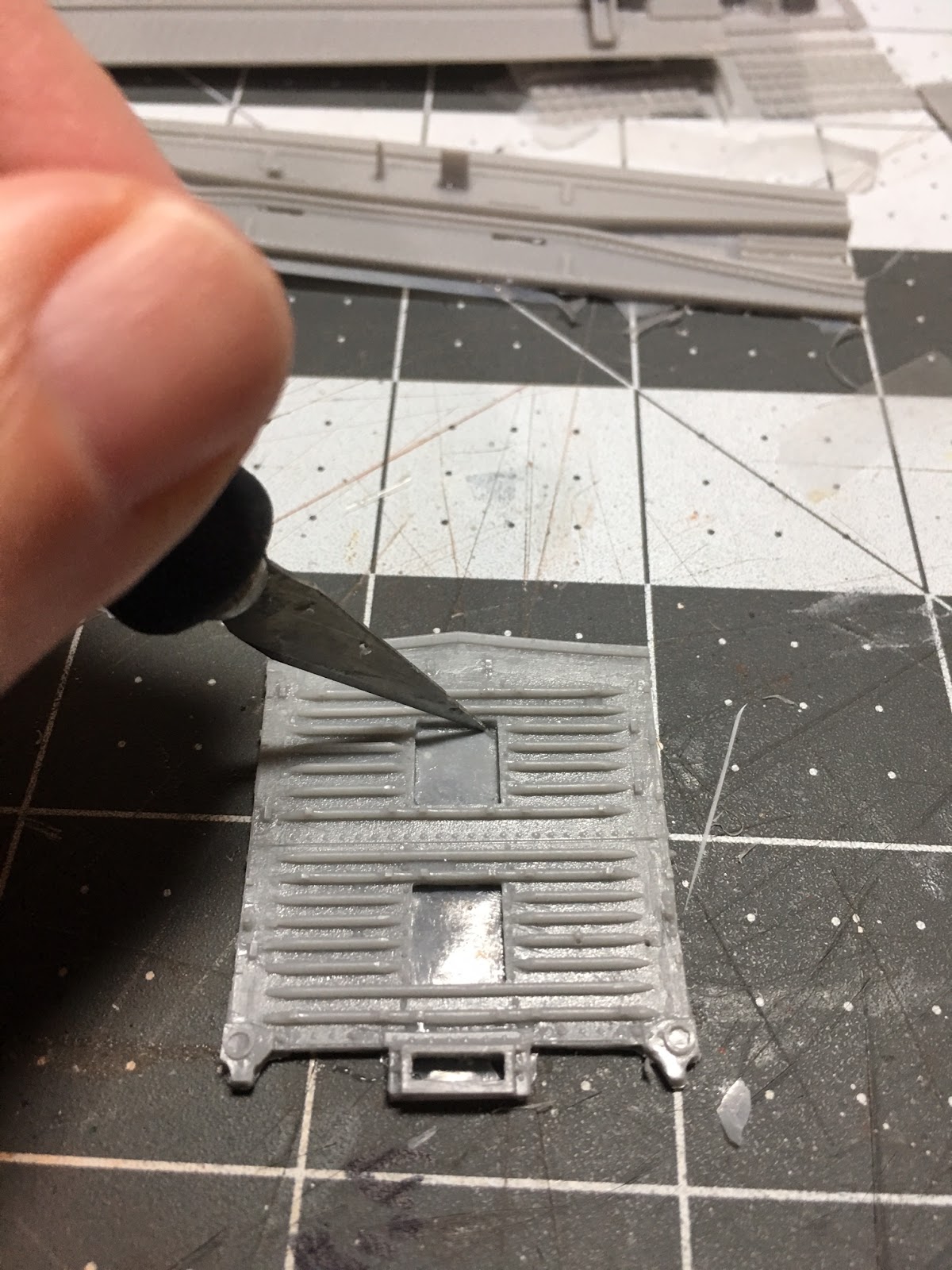
To remove flash from openings, such as the end of this ventilated boxcar, I use a hobby knife and trim the resin flash to the edges, then use sanding sticks and/or files to true up the openings. 


Sunday, September 3, 2017

Westerfield I-GN boxcar - ready for weathering

I finished dealing the Westerfield I-GN boxcar, and added an overcoat of Future floor polish followed by a coat of Vallejo Matte clear. I think it makes a nice addition to the "late 1920s" roster. 

I think I'm going to hold off on weathering the car until I get some other half-finished freight car projects completed. 

Tuesday, August 22, 2017

Westerfield I-GN Boxcar


As I was sorting and packing some of the smaller items that reside in various small plastic containers, I came across the decals for a Westerfield International Great Northern 40-foot single sheathed boxcar that I'd built almost two years ago.
Having no idea how the decals ended up separated from the car, and knowing full well that it would happen again if I didn't take drastic measures, I opted to spend a pleasant hour or so this past Sunday evening getting the decals on one side of the car. Side #2 has since been completed.
For the record, and my reference, the car was painted with a base coat of Vallejo "Boxcar Red" sold by Micro-Mark. The Vallejo labels reveals they refer to this color as "Rust." The paint was allowed to dry completely (although the 26 months this paint dried may have been excessive!) before I hit the model with an airbrushed coat of Future clear acrylic (or whatever they're calling it this week).  
When this photo was taken I hadn't yet "snuggled"* the decals in place, which is why there's so much decal film showing.  When I decal a car I like to leave it on the modeling desk for a week or so - every evening I'll add another application of Microscale setting solution. After a few days of this most of the film disappears. 
Once the decaling was complete I added an overcoat of Future floor polish, followed by a coat of Vallejo Matte clear. 

I'm going to hold off on weathering the car until I get some other half-finished freight car projects completed. 
Sharp-eyed freight car fanatics will note this car is lettered to reflect lettering styles that predate my typical 1950s roster. 
No further comment on that at this time.  


*When I was on the Model Railroader staff we were always debating the best way to describe of process of softening decals using settling solution to get them to conform to the various details, ridges, rivets and the like. Somehow, someone (likely Jim Kelly, it sounds like something he'd come up it!) suggest the term "snuggling" the decals....it stuck.

Monday, October 3, 2016

Boxcar Percentages Through White River Junction, Vt., circa 1954

A few years back several members of the Central Vermont Railway Historical Society tabulated the total number of boxcars (and only boxcars) going through White River Jct, VT over a several day period in 1954. (The period and locale were chosen because there were relatively complete train lists for that period of time). 
I thought this might help guide the creation of an accurate freight car fleet for the layout (by percentage of road name) so I was very interested in the results. After looking the resulting data I'm not convinced it's helpful for modeling purposes. 
The sample total was 3,605 cars. There were approximately 60 unique reporting marks represented (basically, name a North American railroad of the time and it appears at least once ...)
By far the most common roadname, with more than 50% of the total, was Canadian National. Since the CV was a subsidiary of the CN, that's not shocking.  The inclusion of CV in the "top ten" in this summary is logical (White River Junction is on the CV, after all), but certainly would not be applicable if one was to take this list and use it to develop a roster for a layout set anywhere else in the country.
I prepared the somewhat useless pie chart above to include an image with the blog post - I'm afraid there's little useful data to be gleaned from it - except that if you go with a statistical approach to a modeled fleet 3/4 or so of the fleet should be made up of boxcars from the ten railroads listed. 

The table below shows the breakdown by roadname of most of the remaining 55+ reporting marks. 


Each accounted for far fewer cars - or for a total so small it was insignificant.
I noted the percentage of the total by roadname didn't come even remotely close to reflecting the national fleet, although the totals seem to reflect some regional "bias" (greater percentages of New England/Northeastern region road names, but not by much). I was especially shocked at how few NYC and PRR cars (based on the % of these roads rosters compared with the national fleet at the time) appeared in the sample data. 

Not sure what I learned from this exercise, except that out of a fleet of 100 boxcars fully half should be CN, with almost any other road name represented provided you don't include too many of any one road name. 
There's a caveat to all this of course. If one were to model a roster to these percentages and then compare the resulting trains to prototype photos, the resulting car fleet may be defended as somewhat "authentic," but I doubt the trains on the resulting layout would really look right!